What Is GAMSTOP and How Does It Work?
Learn what GAMSTOP is, when it launched and how UK self-exclusion works. We also explain non-GAMSTOP casinos, licensing differences, core player protections and the importance of responsible gambling.
What Is GAMSTOP and How Does It Work?
GAMSTOP is one of the most important safer-gambling tools in the United Kingdom. It allows a person to place a single self-exclusion across online gambling businesses licensed in Great Britain, instead of asking every operator to block their account separately. That sounds simple, but questions often remain: who runs the scheme, when did it begin, what information does it use, and why do some gambling websites sit outside it?
This guide explains GAMSTOP's history, operation and limits in plain language. It also defines non-GAMSTOP casinos without treating them as a shortcut around self-exclusion. The aim is to help readers understand the regulatory difference and make decisions with a clear view of the protections involved.
What Is GAMSTOP?

GAMSTOP, now presented publicly as Gamstop Online, is a free online self-exclusion service available to residents of the UK. Once registered, a user should be prevented from opening or accessing accounts with online gambling companies licensed in Great Britain. It covers different forms of remote gambling, including online casinos, sportsbooks and bingo sites, as long as the operator is within the British licensing system. The official GAMSTOP explanation describes the service as a way to block oneself from gambling websites and apps for a chosen minimum period.
The scheme is operated by The National Online Self Exclusion Scheme Limited, a not-for-profit organisation that states it is independent of both government and the gambling industry. GAMSTOP is therefore not a casino, payment provider, addiction-treatment service or gambling regulator. The UK Gambling Commission sets licensing requirements for operators, while GAMSTOP administers the shared self-exclusion system.
Its scale shows why the distinction matters. In July 2026, Gamstop Online reported that 614,738 consumers were registered and that registrations during the first half of 2026 were 16% higher than in the same period of 2025. Registration numbers do not measure gambling harm by themselves, but they demonstrate that a large number of people use self-exclusion as a practical boundary.
When Was GAMSTOP Introduced?
GAMSTOP launched in April 2018. It is more accurate to use that date than to say simply that GAMSTOP was 'founded', because the operating organisation and the public service do not share exactly the same starting point. For readers asking when GAMSTOP began blocking online gambling accounts, April 2018 is the relevant date.
Participation was not compulsory for every British-licensed remote operator from the first day. The decisive regulatory change arrived on 31 March 2020, when all online gambling operators licensed by the UK Gambling Commission were required to participate. The Commission's 2020 announcement explained that the multi-operator system would let consumers self-exclude through one request rather than approaching hundreds of operators individually.
This creates a useful two-date timeline: 2018 was the public launch, and 2020 was the point at which participation became a licence requirement across the British online market. A UKGC-licensed online operator that fails to integrate with GAMSTOP can face regulatory action.
How Does GAMSTOP Work?
GAMSTOP works by matching the personal information supplied during registration against information held by participating gambling operators. It is designed to identify both existing accounts and attempts to create new ones. The process can be broken into four main stages.
1. The User Registers and Confirms Their Identity
Registration requires a person's full name, date of birth, home address and postcode, email addresses and mobile numbers. Users are asked to include current details as well as previous details that may have been used with gambling accounts. An email address must be verified, and the service also completes an identity check. Accurate information is essential: a different spelling, old address, secondary email or changed phone number can make matching less effective if it is not included.
2. A Minimum Exclusion Period Is Chosen
The available options are six months, one year, five years, or five years with automatic renewal. The current GAMSTOP terms of use make clear that an active exclusion cannot be cancelled during its minimum period. This is a central feature rather than an inconvenience: self-exclusion is intended to remain in place when a person's short-term motivation changes.
3. Participating Operators Check for a Match
Once the exclusion is active, participating companies check GAMSTOP when a person tries to register or access an account. A positive match should lead the operator to prevent access to its online gambling services. GAMSTOP says registration takes only a few minutes but the block can take up to 24 hours to become effective. Users should not attempt to gamble during that window.
The block does not automatically return money left in a gambling account. Anyone with withdrawable funds must contact the relevant operator and follow its account-closure or withdrawal process. The operator, rather than GAMSTOP, is responsible for returning the balance.
4. The Exclusion Continues Until It Is Formally Removed
Reaching the end of the selected six-month, one-year or five-year period does not instantly reactivate gambling accounts. A user who wants the exclusion removed must wait until the minimum period has expired, contact GAMSTOP and complete the removal process. There is then a cooling-off period of at least 24 hours. Alternatively, the person can extend the exclusion. If no removal is requested, the block can remain in place for a further period under the scheme's current terms.
What Gambling Does GAMSTOP Cover?
The coverage is broad within its intended area but it is not universal. All online gambling companies licensed in Great Britain must participate. This includes licensed casino, betting, poker and bingo websites and apps. The block concerns the operator's remote services, so it may also affect access to free-to-play features attached to a licensed gambling account.
The same principle applies to sports wagering: British-licensed bookmakers are included, while international betting sites not on GAMSTOP sit outside the shared database. The label describes participation in the exclusion scheme; it does not by itself establish a site's quality, licensing strength or suitability.
GAMSTOP does not block entry to physical betting shops, casinos, bingo halls or adult gaming centres. Separate multi-operator exclusion arrangements exist for several land-based sectors. National Lottery draw games, including Lotto and EuroMillions, are also outside GAMSTOP, although online instant-win games and online scratchcards are covered. These boundaries are important for anyone building a wider protection plan.
What Are Non-GAMSTOP Casinos?
Non-GAMSTOP casinos are online casinos that are not connected to the national self-exclusion database. In practice, they are generally international operators without a UK Gambling Commission licence. They may hold a licence issued in another jurisdiction and may provide their own limits, time-outs or account-level self-exclusion, but those tools do not create a block across every British-licensed gambling website.
The terms 'non-GAMSTOP' and 'non-UK casino' overlap, but they are not perfect synonyms. 'Non-GAMSTOP' describes the relationship with a self-exclusion scheme. 'Non-UK' describes the operator's licensing or regulatory position. Our guide to non-UK casinos explains why an overseas casino may block British registrations, while another may accept them despite not holding a British licence.
A foreign licence must not be confused with authorisation to serve Great Britain. The UK Gambling Commission states that an operator needs a Commission licence to provide remote gambling facilities to consumers in Great Britain, regardless of where the business is based. It also states that a licence issued in another country does not replace that requirement. A website being accessible, accepting GBP or allowing a UK postcode is therefore not evidence of UKGC authorisation.
Consumer protections can also differ. A player at a UKGC-licensed operator benefits from British rules on identity checks, complaints, safer-gambling interaction, marketing and technical standards. At an international casino, the applicable rules and complaint route depend on the overseas regulator and the operator's terms. Verification may still be required, withdrawals may be capped, and a dispute may be harder to escalate. 'Not on GAMSTOP' should never be treated as a safety rating.
GAMSTOP Casinos vs Non-GAMSTOP Casinos
The central difference is not the size of a bonus or the number of games. It is the regulatory framework and whether a national exclusion is recognised.
| Point | GAMSTOP-covered operator | Non-GAMSTOP casino |
|
Typical licensing position |
Licensed by the UK Gambling Commission |
Usually licensed, if at all, outside Great Britain |
|
GAMSTOP check |
Required |
Not connected to the shared database |
|
Self-exclusion |
Applies across participating British-licensed sites |
Usually limited to the operator or its group |
|
Consumer protection |
UKGC rules and British complaint requirements |
Depends on the overseas licence and operator terms |
|
Main reader check |
Confirm the licence on the UKGC register |
Verify the operator, licence, jurisdiction, restrictions and complaint route |
Neither column guarantees that every operator will behave perfectly. Licensing still needs to be checked on the exact domain being used, and published terms should be read before an account is funded.
Should a Self-Excluded Player Use a Non-GAMSTOP Casino?
No. A person who joined GAMSTOP because gambling was becoming difficult to control should not use an international casino to work around that decision. The fact that a technical block does not reach every website does not mean the purpose of the exclusion has ended. Seeking a route around it can recreate the same financial and emotional harm that prompted registration.
This is also why an educational explanation of non-GAMSTOP casinos must be careful with language. Such sites can be discussed as a market category, but they should not be promoted as a solution for someone who is actively self-excluded. Readers who are not self-excluded still need to understand the reduced British regulatory protection and assess whether gambling is appropriate for them at all.
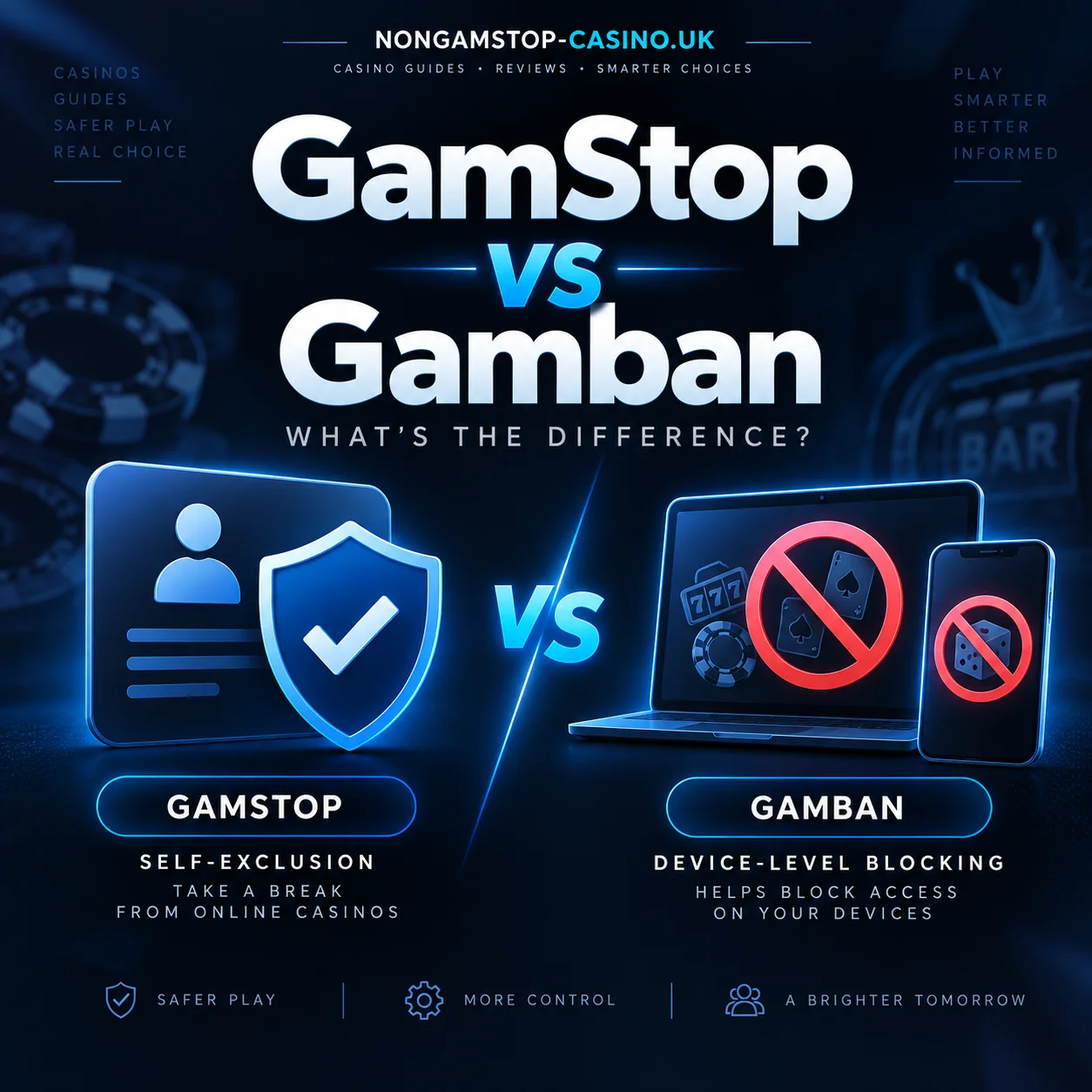
Anyone struggling to stop should strengthen the barrier rather than test it. Practical steps can include activating a gambling block with a bank, installing device-level blocking software, excluding from land-based venues, removing gambling apps and advertising, and speaking to a support service. Our responsible gambling guide lists support contacts and additional tools in one place.
Is GAMSTOP Enough on Its Own?
GAMSTOP is a powerful tool, but its own terms describe it as an aid rather than a foolproof guarantee. Its effectiveness depends partly on the accuracy of the information supplied. Users should keep their name, addresses, email accounts and phone numbers updated so operators can match new registration attempts against the correct record.
A layered approach is usually stronger. Bank gambling blocks can interrupt payments, blocking software can restrict access at device level, and marketing controls can reduce exposure to promotional messages. People who also gamble in person should use the relevant exclusion schemes for betting shops, casinos, bingo venues or arcades. Professional support can address the behaviour and circumstances behind the gambling, which a technical block cannot do by itself.
Friends or family members cannot normally register another adult without lawful authority. They can, however, offer practical support, encourage the person to register, help install additional controls and protect shared finances where appropriate. In an urgent financial or mental-health situation, specialist assistance should take priority over researching gambling websites.
Frequently Asked Questions
Can GAMSTOP Be Cancelled Early?
No. The exclusion cannot be removed during the selected minimum period. After that period expires, the user must complete the formal removal process and wait through a cooling-off period of at least 24 hours.
Does GAMSTOP Block Every Gambling Website?
No. It covers online operators licensed in Great Britain. It does not cover unlicensed or overseas operators outside the scheme, and it does not provide the relevant block for physical gambling venues.
Will GAMSTOP Automatically Return Account Funds?
No. The customer must contact each gambling operator about withdrawable money. The operator's verification and account-closure process will determine how the balance is returned.
Conclusion
GAMSTOP launched in April 2018 and became mandatory for all UKGC-licensed online gambling operators on 31 March 2020. It gives UK residents one route to exclude themselves from British-licensed gambling websites and apps for six months, one year, five years, or five years with automatic renewal. Once active, the minimum period cannot be cancelled early.
Non-GAMSTOP casinos sit outside that shared system, usually because they do not hold a UK Gambling Commission licence. Their existence illustrates the limit of a national database, not a weakness that self-excluded users should exploit. The safest interpretation is straightforward: GAMSTOP is a protective commitment. It works best when personal details stay current and when it is combined with payment blocks, device controls, offline exclusions and appropriate support.