
Why the Same Casino Game Can Have Different RTPs
The same casino game can have a different RTP at another casino. Learn why providers offer multiple versions and how to check the exact percentage before playing.
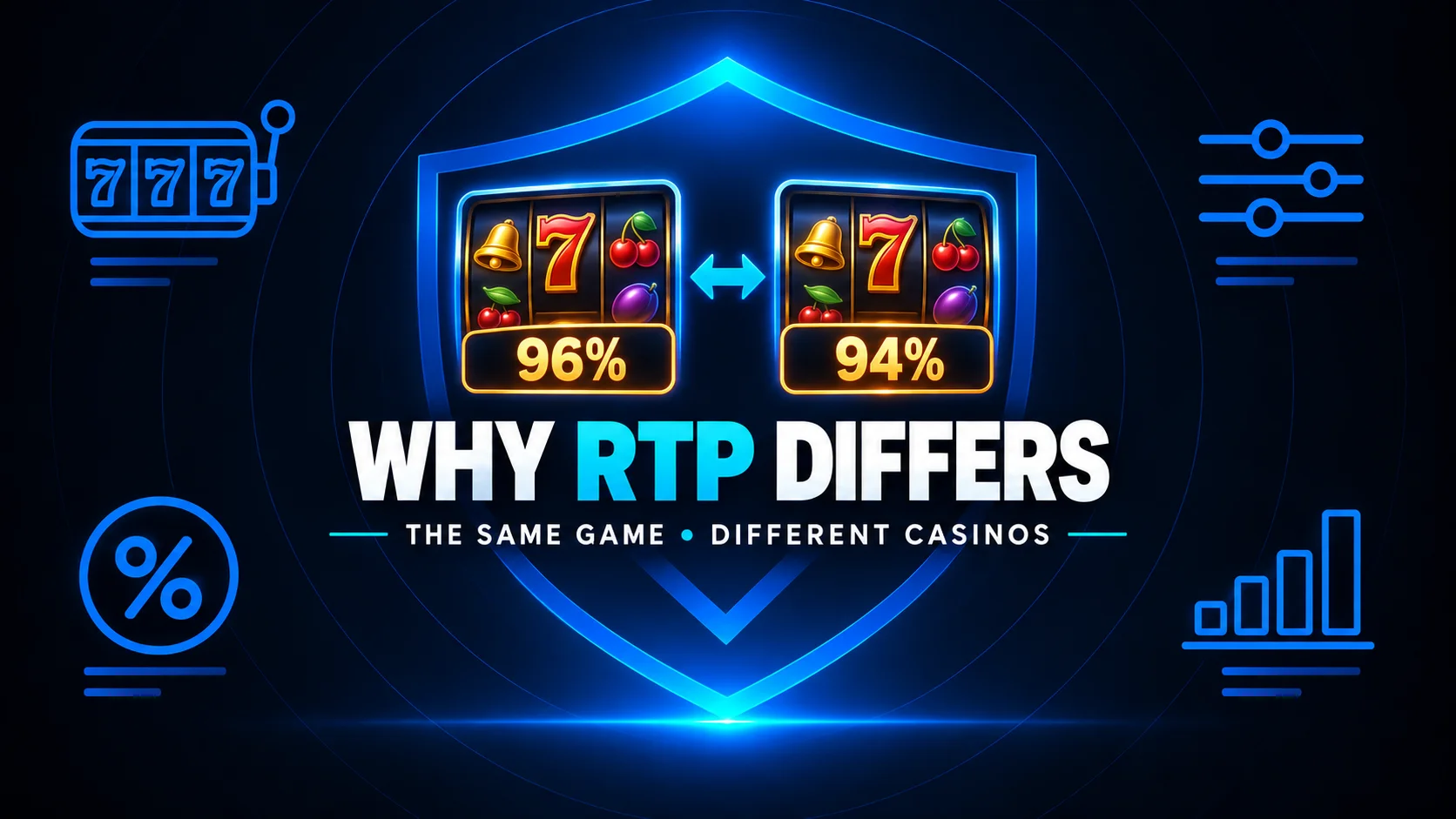
Two casinos can offer the same slot with the same name, artwork and bonus round, yet display different return to player percentages. One version might show 96%, while another shows 94% or less. The difference is usually caused by the game version selected for that casino, rather than a visual change that players can immediately notice.
Many software providers create several tested mathematical configurations for one title. The operator, platform or game aggregator then deploys one of those configurations for a particular casino or market. The active percentage should be shown inside the game’s own information or rules panel. That figure is more useful than an RTP copied from an old review, search result or provider announcement.
This guide explains why the same casino game can have different RTPs, how much the difference can matter over repeated play and how to check the exact version before staking money.
What RTP Actually Measures
Return to player, normally shortened to RTP, is the theoretical percentage of all qualifying stakes that a game is designed to return over a very large number of rounds. The UK Gambling Commission’s RTP guidance distinguishes the theoretical RTP built into the game from the actual RTP recorded after real play.
A slot with a theoretical RTP of 96% has a corresponding theoretical house edge of 4%. Across a sufficiently large amount of turnover, the game is designed to return about £96 for every £100 wagered and retain about £4. This is an average across the game’s full mathematical model. It is not a promise that one player will receive £96 after staking £100.
Short sessions can finish far above or below the published figure. A player may lose an entire deposit, finish close to the starting balance or win many times the original stake. Volatility determines how widely results can move around the long term average. The theoretical percentage becomes more meaningful only as the number of rounds grows.
Why the Same Casino Game Can Have Different RTPs
Providers Can Create Several Approved Versions
The game studio designs the mathematics behind a slot. It can submit several versions of the same title for testing and certification. Each version may use the same graphics, sounds, paylines and bonus theme while assigning different probabilities or prize contributions behind the interface.
This practice is visible in official provider catalogues. For example, Blueprint Gaming’s page for The Goonies Deluxe Rapid Fire lists separate game IDs at 91%, 92% and 94% before the Rapid Fire contribution. The listing makes clear that several mathematical versions can sit under one recognisable product name.
The Casino or Platform Selects a Deployment
Once the provider has created and tested the available configurations, the casino or its platform partner can select the version offered through that lobby. The choice may reflect commercial terms, local tax, regulatory requirements, jackpot structure or the operator’s target margin. An aggregator may also manage the technical integration between the provider and casino.
The casino is therefore choosing from versions supplied through the provider’s system. In a legitimate integration, it is not manually deciding whether an individual spin should win or lose. Each round is produced by the approved game and random number generation process attached to the active version.
Markets and Features Can Require Different Builds
A provider may offer different builds for regulated markets, international casinos, jackpot networks or feature modes. Some jurisdictions restrict particular mechanics. A casino may also carry a standard version in one country and another configuration through a different domain or platform.
Feature purchases, enhanced bets and progressive jackpots can complicate the figure further. Some games disclose a separate RTP for the base game and an optional mode. Others include a jackpot contribution in the total percentage. Players should read the full information panel instead of assuming one number covers every way of playing.
How a Small RTP Difference Changes the Long Term Cost
A difference of two percentage points can look minor on one spin. It becomes more significant as turnover increases. Turnover means the total amount staked, including money that is won and then wagered again. A £100 deposit can therefore create much more than £100 of turnover during a long session.
|
Game RTP |
Theoretical house edge |
Theoretical return on £1,000 turnover |
Theoretical amount retained |
|
96.5% |
3.5% |
£965 |
£35 |
|
96% |
4% |
£960 |
£40 |
|
94% |
6% |
£940 |
£60 |
|
92% |
8% |
£920 |
£80 |
At 96%, the theoretical cost of £1,000 in turnover is £40. At 94%, it is £60. The expected difference is £20 across that volume of play. Actual results can be much better or worse because individual sessions are affected by variance. The table describes long term mathematical expectation, not a forecast for the next session.
How the Game Mathematics Can Change
The provider does not need to redesign the entire slot to produce another RTP version. The visual experience can stay almost identical while the underlying probabilities change. Depending on the game, a lower configuration may adjust symbol weighting, prize frequency, bonus frequency, feature contribution or part of the paytable. The exact method is normally proprietary to the studio.
That is why screenshots are poor evidence of RTP. Two versions can show the same reels, characters and advertised maximum win. The game rules and mathematical identifier are the useful checks. Even the maximum win does not reveal how often the game is expected to reach large prizes.
Can a Casino Change a Game’s RTP Whenever It Wants
A reputable operator cannot normally move the percentage up and down during a player’s session like a live control. The active game is deployed through the provider or remote game server using a defined mathematical configuration. In regulated markets, the relevant software, rules and percentage are subject to testing, approval and monitoring requirements.
A casino can replace one approved version with another when its catalogue or platform configuration changes. The timing and controls depend on the provider, licence and jurisdiction. For that reason, an RTP checked months ago should not be treated as permanent. Open the information panel again after a site migration, game update or long absence.
Missing rules deserve caution. If a game does not disclose its RTP, loads from an unfamiliar source or shows information that conflicts with the recognised provider version, stop before staking money. A familiar logo alone does not prove that a game is authentic.
How to Check the Exact RTP Before Playing
The live game panel is the best place to verify the version currently offered by a casino. Use the following process on the exact website and account you intend to use.
- Open the game from the casino lobby. Use demo mode if it is available, but confirm that the rules match the real money version.
- Select the information, help, paytable or menu icon. On mobile, it may sit behind a three-line menu or settings symbol.
- Search for “RTP”, “return to player”, “theoretical return” or “game rules”. Record the percentage shown for that version.
- Check whether the game lists separate percentages for the base game, feature purchase, enhanced bet or jackpot mode.
- Repeat the check at another casino if you are comparing the same title. Do not assume that matching artwork means matching mathematics.
- Take a dated screenshot if the figure materially affects your decision. Game versions and site integrations can change.
Casino support can clarify where the figure appears, but the written game rules should remain the primary reference. A lobby label such as “high RTP” is too broad to confirm the percentage of a specific title.
Why Casino Reviews Sometimes Show a Different RTP
A review may quote the provider’s default or highest published configuration. The casino being reviewed may run another approved version. The article may also have been written before a platform change, or the writer may have checked a demo hosted on the provider’s website instead of the game inside the casino.
Location can create another mismatch. A search result from one country may describe a different market build from the version available through a UK-facing or international domain. Bonus Buy and jackpot modes can also produce percentages that do not match the base figure cited in a general review.
Our editorial approach is to treat the percentage inside the live game rules as the source for that deployment. A provider page is useful for learning how the title was designed, while an older review remains useful for mechanics and features. Neither should override the current figure shown in the game being opened.
RTP, Volatility and Hit Rate Are Different
RTP is only one part of a slot’s mathematical design. A higher percentage does not tell you how often wins occur, how large they tend to be or how uneven the session may feel.
|
Measure |
What it describes |
What it does not predict |
|
RTP |
Theoretical share of total stakes returned over extensive play |
The result of one spin or one session |
|
Volatility |
How wins are distributed between smaller frequent prizes and larger rarer prizes |
Whether the next round will win |
|
Hit rate |
How often a round produces any stated winning result |
Whether those wins recover the total stake |
|
Maximum win |
The largest published payout under the game rules |
How likely that result is to occur |
If two versions are otherwise identical, the higher RTP has the lower theoretical house edge. That still does not make it safe or profitable. A highly volatile 96% slot can produce a harsher short session than a lower volatility game with a slightly lower percentage. Stake size and time spent playing can matter more to the immediate result.
RTP at Non UK Casinos
International operators often build their lobbies through several providers and aggregators. The available games, features and RTP configurations can vary by casino, country and domain. Our Non UK Casinos guide explains the wider differences in licensing, payments, verification and player protection. Readers interested mainly in software catalogues can also compare our slot sites not on GamStop page.
Large lobbies do not guarantee that every title uses its highest available configuration. When comparing platforms covered in our 1Red review, MyStake review or Freshbet review, use the reviews to assess the broader casino and open the individual game panel to verify its current RTP. The presence of a recognised provider does not establish one fixed percentage across every operator.
How RTP Interacts With Casino Bonuses
Wagering requirements create turnover, which makes the game percentage relevant to the expected cost of completing a bonus. If a £100 bonus has a 30x requirement on the bonus amount, the required qualifying turnover is £3,000. A two-point RTP difference represents £60 of additional theoretical cost across that turnover, although the player’s actual result may differ sharply.
RTP is only one bonus factor. A game may contribute less than 100% towards wagering or be excluded. Maximum bet rules can also apply, and some promotions cap winnings from free spins or bonus funds. Check the bonus terms and the in-game RTP together before accepting an offer.
Practical RTP Checklist
- Check the RTP inside the exact game and casino you intend to use.
- Confirm whether optional features or jackpots use a separate percentage.
- Compare volatility and stake size alongside RTP.
- Treat provider pages and reviews as references, then verify the live version.
- Recheck after a game update, casino migration or long break.
- Avoid games that hide basic rules or provide conflicting information.
RTP should help with comparison, not create a false sense of certainty. The game retains a mathematical advantage even at a relatively high percentage, and short term results remain unpredictable. Set a fixed entertainment budget and stop when it is reached. Anyone using GamStop to control harmful gambling should keep that protection in place rather than opening an account outside the scheme.
Frequently Asked Questions
Can the same slot have two different RTPs
Yes. A provider can create and test several mathematical versions of one title. Casinos or platform partners may deploy different approved versions, even when the artwork and main features look the same.
Does a lower RTP mean the game is rigged
A lower RTP does not by itself mean a game is rigged. It can be a legitimate tested configuration with a higher theoretical house edge. The important checks are whether the game is authentic, the percentage is disclosed and the operator and provider are subject to credible oversight.
Can a casino lower the RTP for one player
Legitimate third-party casino games are normally deployed with a defined version for the relevant operator or market. The casino does not select a new RTP for each player or decide individual outcomes. Players should still avoid unverified copies and casinos that hide the game rules.
Is 96 percent RTP good
A 96% RTP is higher than a 94% version of the same game and has a lower theoretical house edge. It still represents a 4% long term edge for the game. The percentage does not guarantee a return during one session.
Where can I find a casino game’s RTP
Open the information, help, rules or paytable panel inside the game. Look for RTP, return to player or theoretical return. Check the version loaded by the casino rather than relying only on a general web search.
Does demo mode always use the same RTP as real money mode
Do not assume that it does. Demo and real money games are often intended to follow the same rules, but a provider-hosted demo or another regional build may use a different configuration. Compare the percentage shown in both versions where possible.
Is RTP the same as volatility
No. RTP describes the theoretical share of stakes returned over extensive play. Volatility describes how unevenly wins are distributed. Two games can have the same RTP while producing very different session patterns.